Solutions

One payment core. Four ways to use it.

The core of DDXPay — payments, ledger, chains, custody — knows nothing about brokers, orders or challenges. What makes it fit your business is configuration and the modules on top, never a separate version of the code.

Brokers

Crypto deposits and the CRM that sells on them.

Banks turn brokers away and card processors are expensive and fickle. DDXPay gives your clients a crypto deposit path you control — and gives your sales and retention teams a CRM that sees the same money.

  • Deposits screened before they count, with your own thresholds per jurisdiction and a review queue for compliance.
  • A funnel from real money — first deposit, qualified first deposit, net deposit — not from numbers someone typed in.
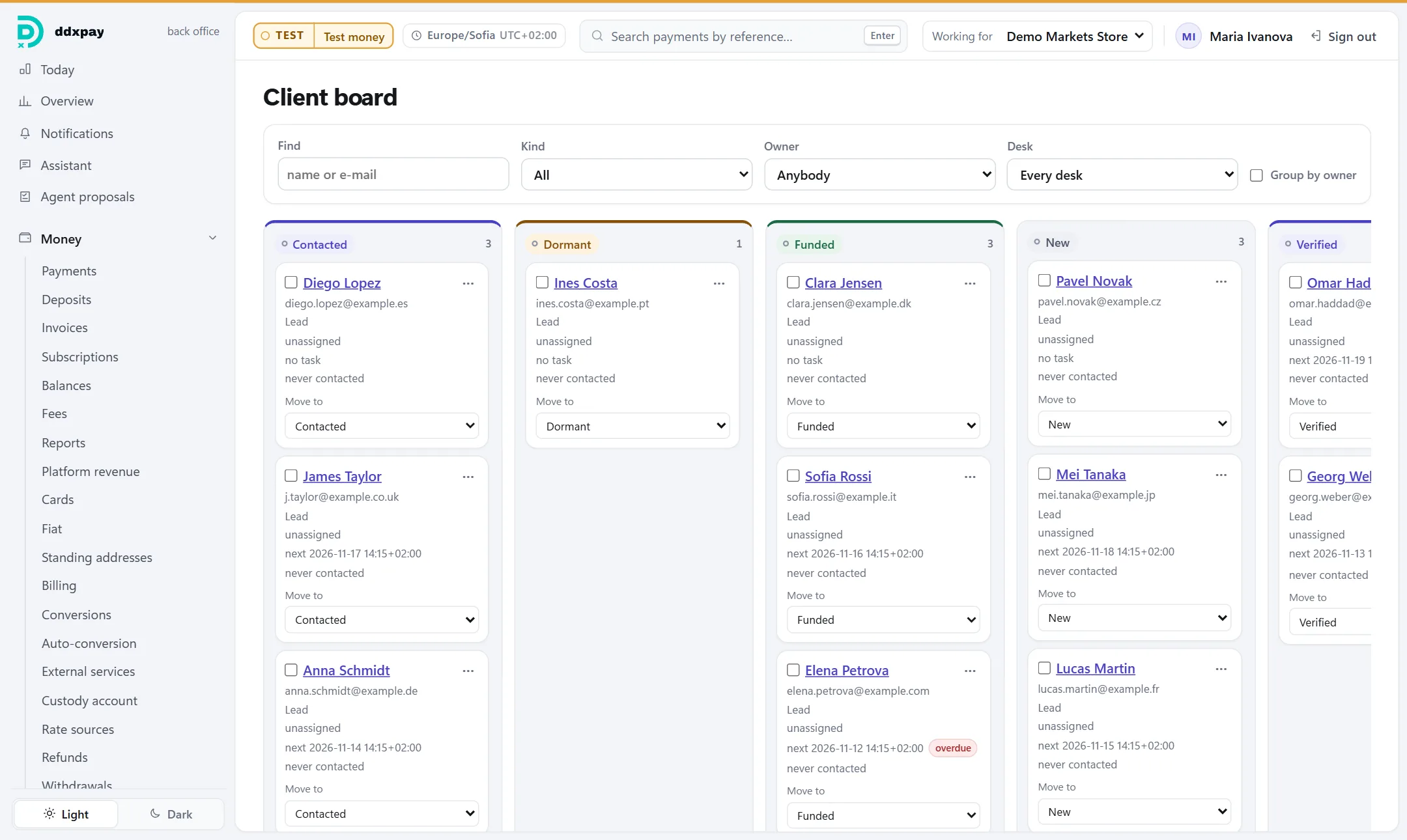
  • Desks, owners and visibility: each salesperson sees the clients their place in the desk tree allows.
  • Auto-conversion so a deposit in ETH or BTC does not carry price risk into your books.

Coming soon: own trading platform and IB portal

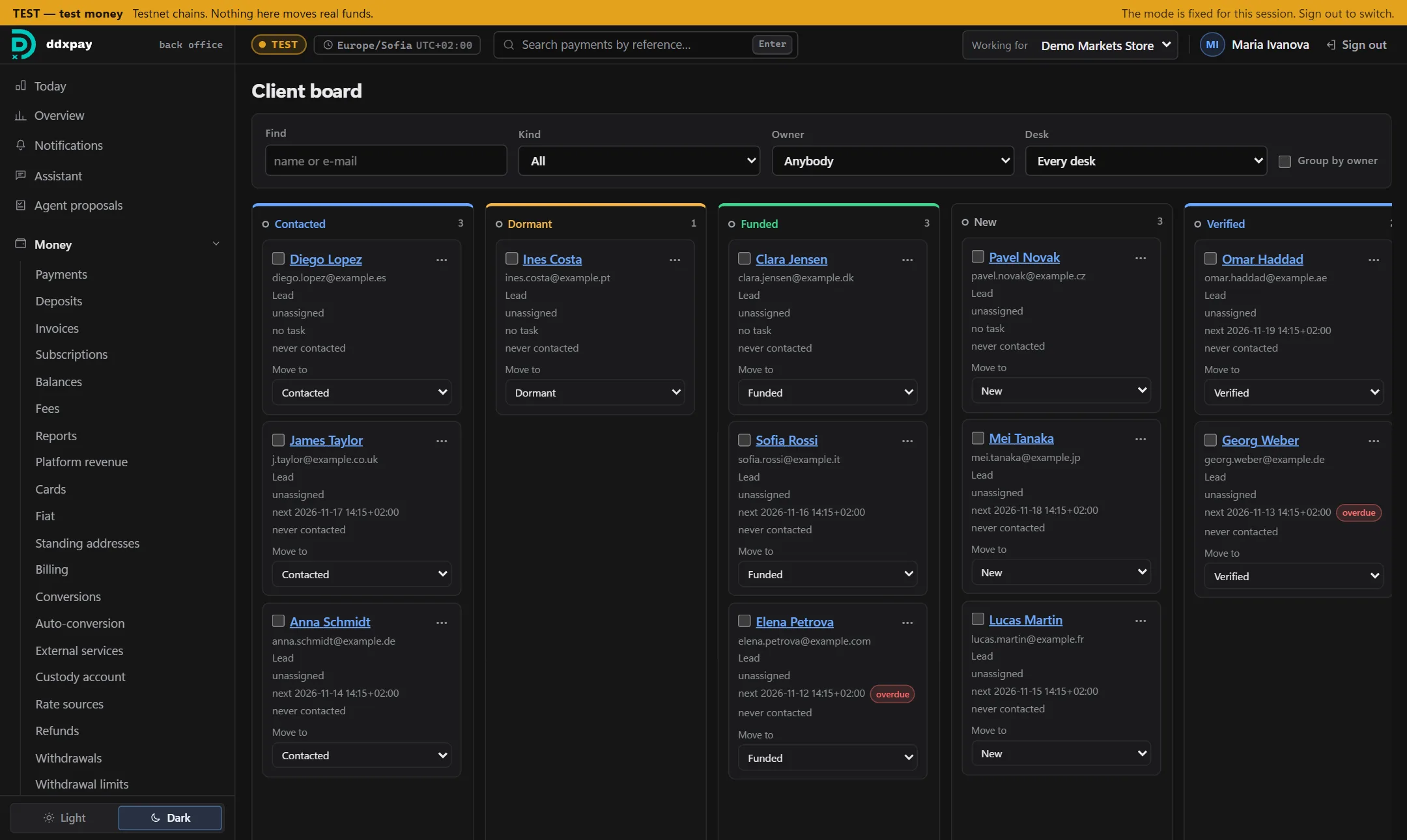
The CRM client board with columns for each client status. The CRM client board in the dark theme.

Why one data layer matters

A broker usually pays for a CRM, pays for a payment provider and then pays an integrator to connect them. When the payment and the client card live in one database, linking a deposit to a client is a click, and the funnel is never out of date.
Prop firms

Money in fast, money out under control.

A prop firm takes many small payments in and sends many payments out. The inbound side needs to be effortless for traders; the outbound side needs to be impossible to abuse from the inside.

  • Challenge fees by link or invoice, priced in fiat, paid in the coin the trader chooses.
  • Payout runs: import a CSV of many withdrawals, review the totals per asset and chain, approve once.
  • The same controls on every line — address allowlist with cooling-off, per-asset limits, free-balance check and four eyes.
  • A full trail of who requested, who decided, who sent and when it was confirmed.

Coming soon: partner commissions and profit split

Four eyes are not a formality

The approver role in DDXPay carries no right to request money, and the requester cannot approve their own request. Even a key issued by an operator cannot carry more rights than the operator who issued it.

One decision instead of three hundred

A payout run is a container of ordinary withdrawals. One line that cannot pass does not stop the others — the failure always leaves money where it was.

Online stores

Crypto at checkout, without changing how the shop works.

A shop needs three things from a crypto payment: a price in its own currency, an order that is marked paid only when the money is really there, and a refund button that works.

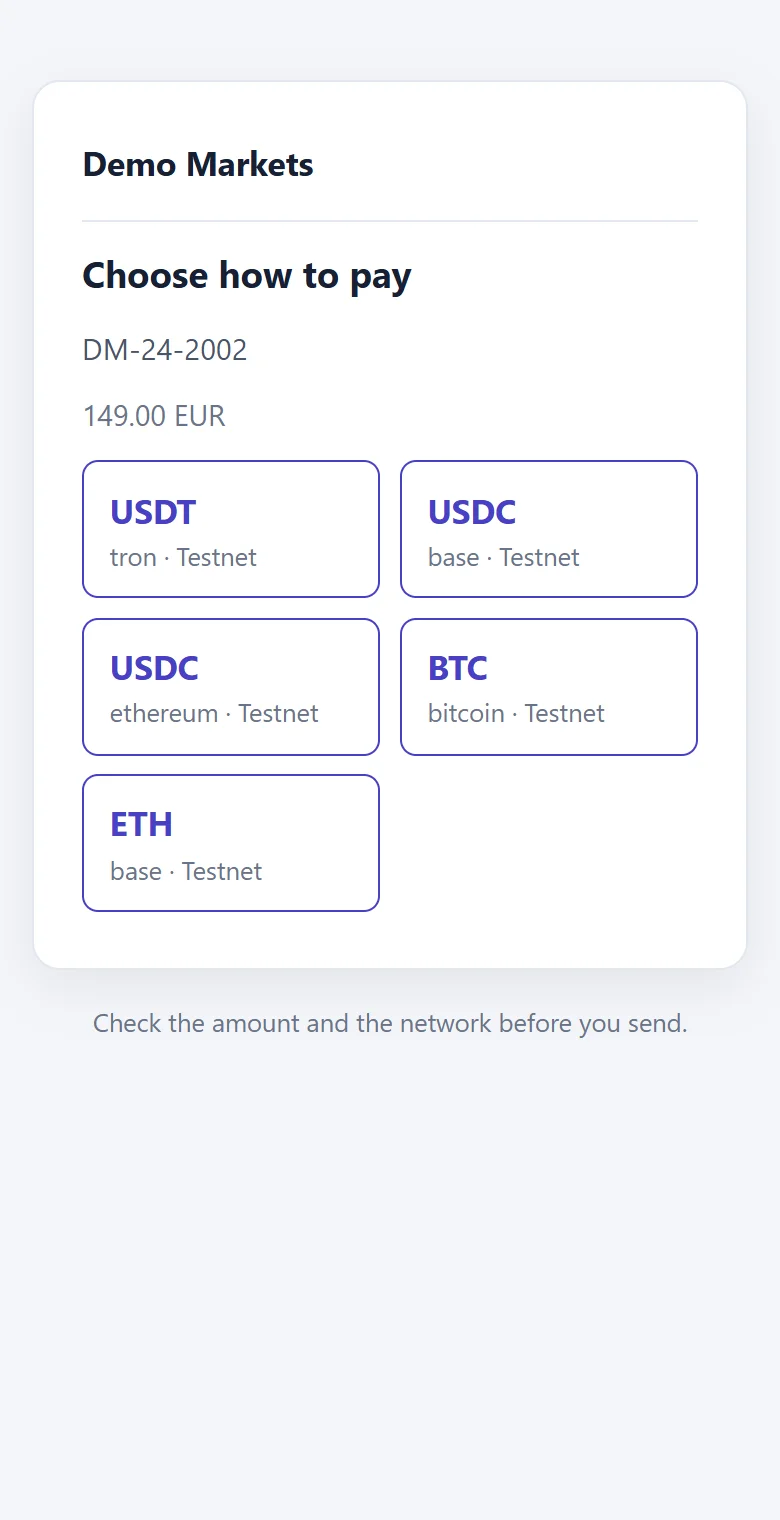
  • WooCommerce plugin: the buyer picks a coin on the hosted payment page, signed notifications mark the order paid, and refunds go out from the order’s Refund button.
  • Hosted page or embedded widget for any other shop, through the public API.
  • Fiat prices with a locked rate; underpaid and overpaid orders are flagged, not silently accepted.
  • Invoices and subscriptions for B2B customers and recurring plans.
  • Cards next to crypto through your own Stripe account.
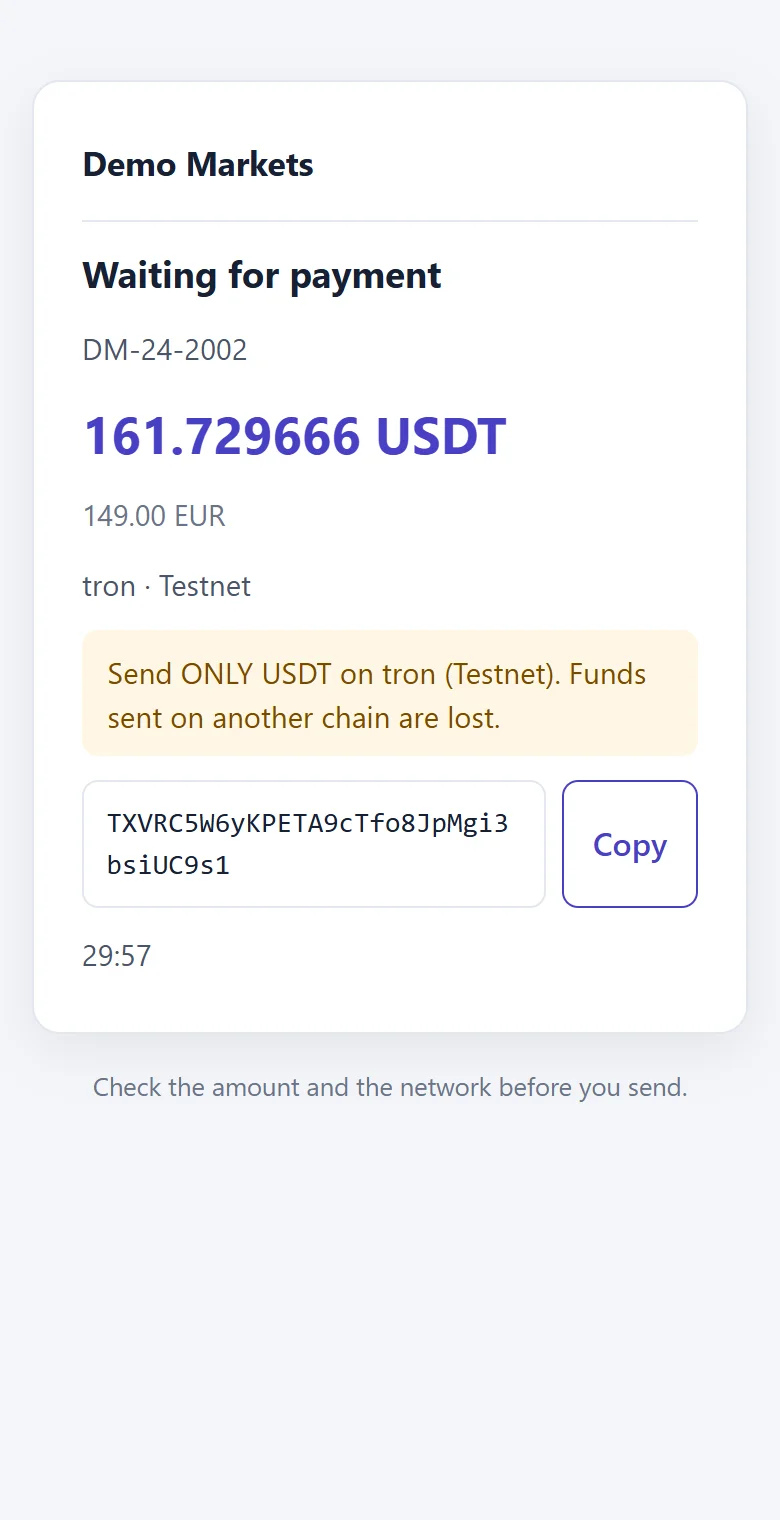
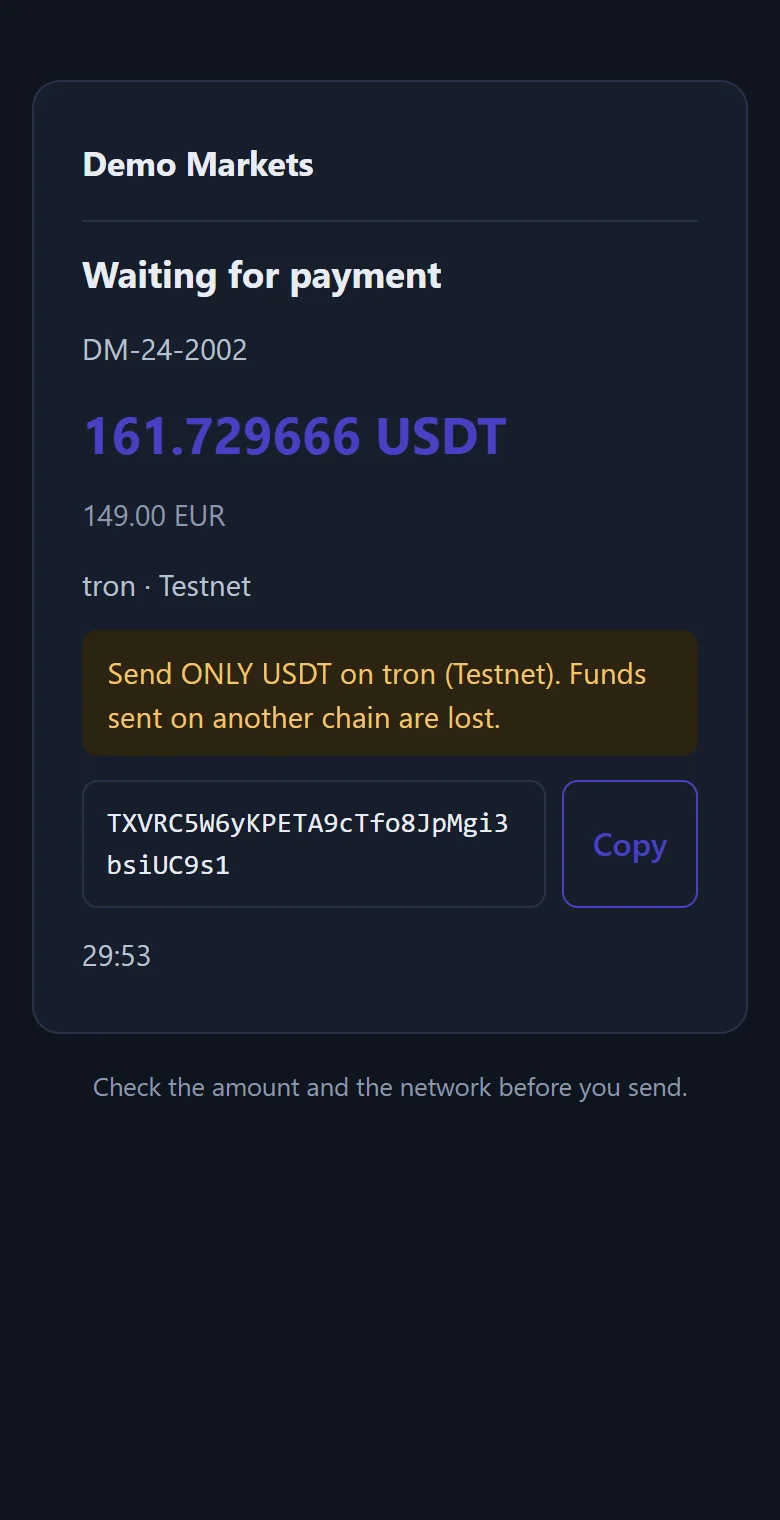
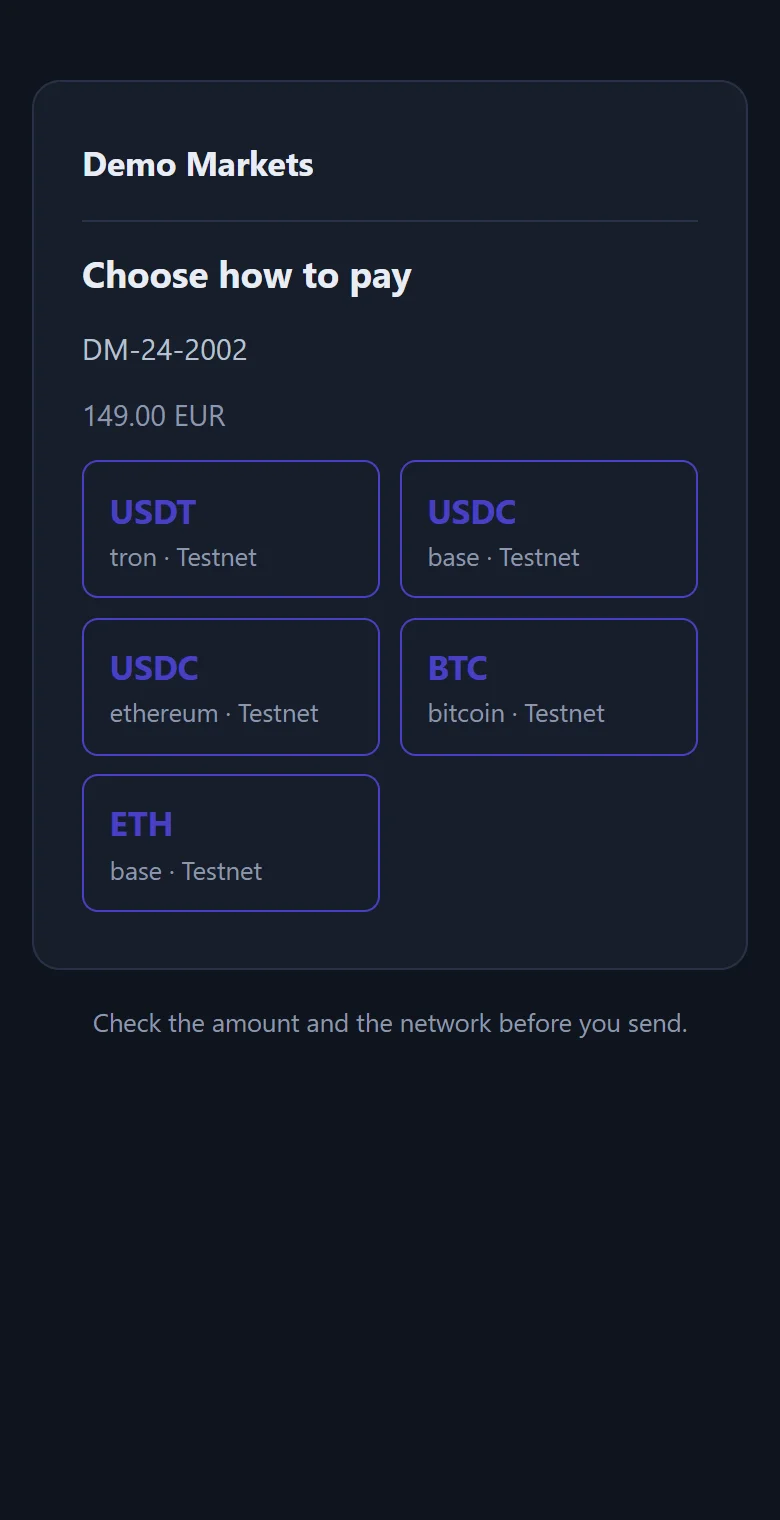
Hosted payment page: choosing a coin for an order priced at 149 EUR. Hosted payment page in the dark theme: choosing a coin. Hosted payment page: the exact USDT amount and the address. Hosted payment page in the dark theme: amount and address.

Refunds and withdrawals leave from a connected custodian account that can send.

PSPs

Infrastructure for many merchants at once.

DDXPay is multi-tenant from the first line of code. A payment service provider can run its merchants side by side, each isolated in the database and configured on its own.

  • A merchant profile with a readiness checklist: risk profile, an API key that can take payments, an active webhook and branding — per mode.
  • API keys per merchant with scopes picked from ready-made profiles, rotation with a grace period, and a key that can never exceed its issuer.
  • Branding, webhooks and risk profile per merchant, with one back office to run them all.
  • Isolation the database enforces: the tenant on every row and the merchant wherever it applies, with row-level security underneath.

Reseller → tenant → merchant

The hierarchy is part of the data model. A person working for the whole tenant chooses which merchant they act for, and everything they do is recorded against that merchant.

Configuration, never a fork

What differs between merchants — vertical, risk thresholds, branding, webhooks, notifications — is configuration. Every merchant runs the same tested code.

Tell us how you sell.

Fees are agreed per client. We will show you the flows that matter to your business, in test mode, on public testnets.