Crypto payment infrastructure for brokers, prop firms, stores and PSPs
Crypto payments, with the back office built in.
DDXPay takes a payment from the customer’s wallet to your ledger: it watches the chain, screens the sender, books the money in a double-entry ledger and tells your systems. The people who run the money — operators, approvers, compliance, sales — work in the same platform.
Risk check · ClearScore 16/100 · review starts at 50
payment_intent.creditedSigned webhook · delivered
Accept on
Tron USDTTRXEthereum USDCUSDTETHBase USDCETHBitcoin BTC
Why DDXPay
Three things other providers sell separately.
A payment provider, a back office and a CRM usually come from three vendors and an integrator in between. Here they share one database and one ledger.
01
Accept crypto without the headache
Hosted payment page, embeddable widget or plain API
Price in a fiat currency; the buyer pays in crypto at a locked rate
Underpaid, overpaid, late and wrong-network payments handled, not lost
Optional automatic conversion to stablecoins on arrival
02
Run the business from one place
Back office with roles: operator, approver, compliance, manager
Four-eyes payouts, address allowlists and limits
CRM whose funnel is built from real deposits, not typed-in numbers
Reports, audit trail and reconciliation with your custodian
03
Ask instead of clicking
An AI assistant that uses the same operations as the menu, within your rights
It reads on its own; anything that changes data waits for a person
Connect your own Claude or other MCP client with an API key
Off until you turn it on, with your own model key
How a payment flows
From the customer’s wallet to your ledger — and nothing counted twice.
Every deposit takes the same path, in test mode and in live mode. Each step records what it decided and why, so a person can always see where a payment is and what it is waiting for.
Customer pays
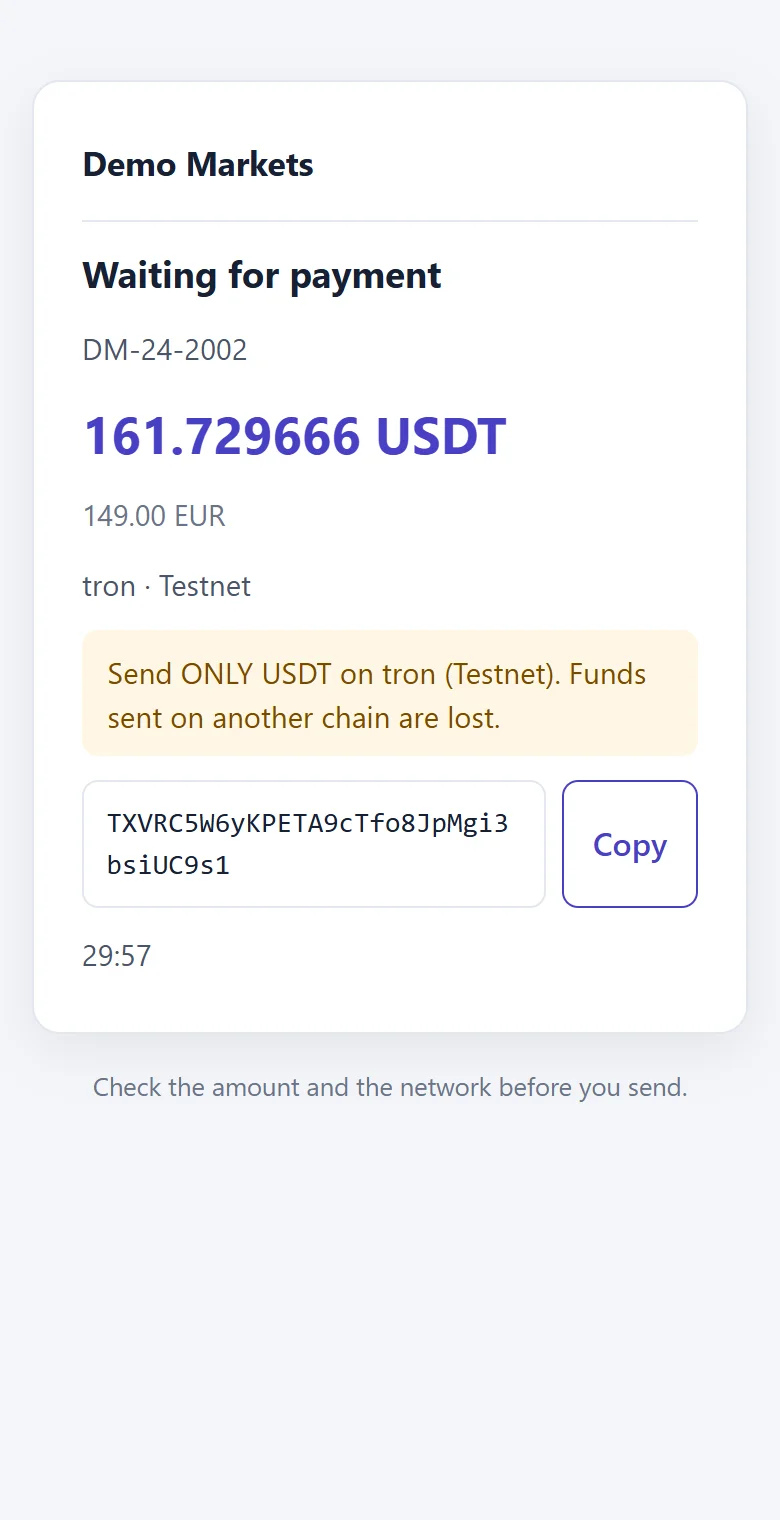
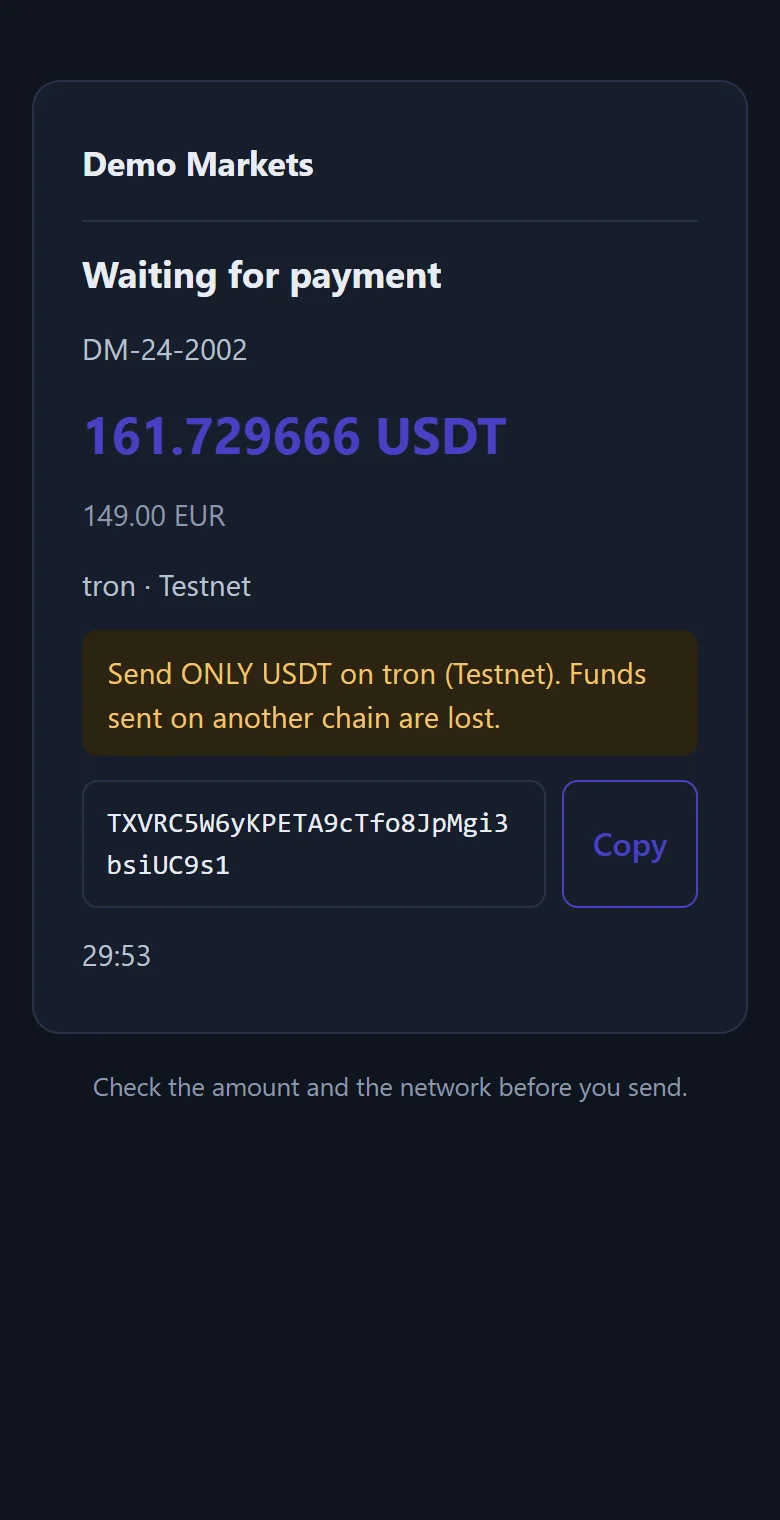
On your page, our hosted page or by invoice link. The buyer can choose the coin and network you accept.
The chain is watched
Confirmations are counted per amount. A transaction is recorded exactly once, and a reorganised block is reversed by a compensating entry.
The sender is screened
Sanctions first, always. Then a risk score against your thresholds: clear, review by a person, or quarantine.
ClearReviewQuarantine
Money is booked
A balanced double-entry transaction credits the merchant and takes the fee. Money held for review is booked too, outside the spendable balance until a person releases it.
Your systems know
A signed webhook reaches your server, retried if it fails; e-mail and in-app notifications reach your people.
Want stablecoins, not volatility? An auto-conversion rule turns an incoming ETH, TRX or BTC deposit into the stablecoin you choose right after it is credited, within a slippage limit you set.
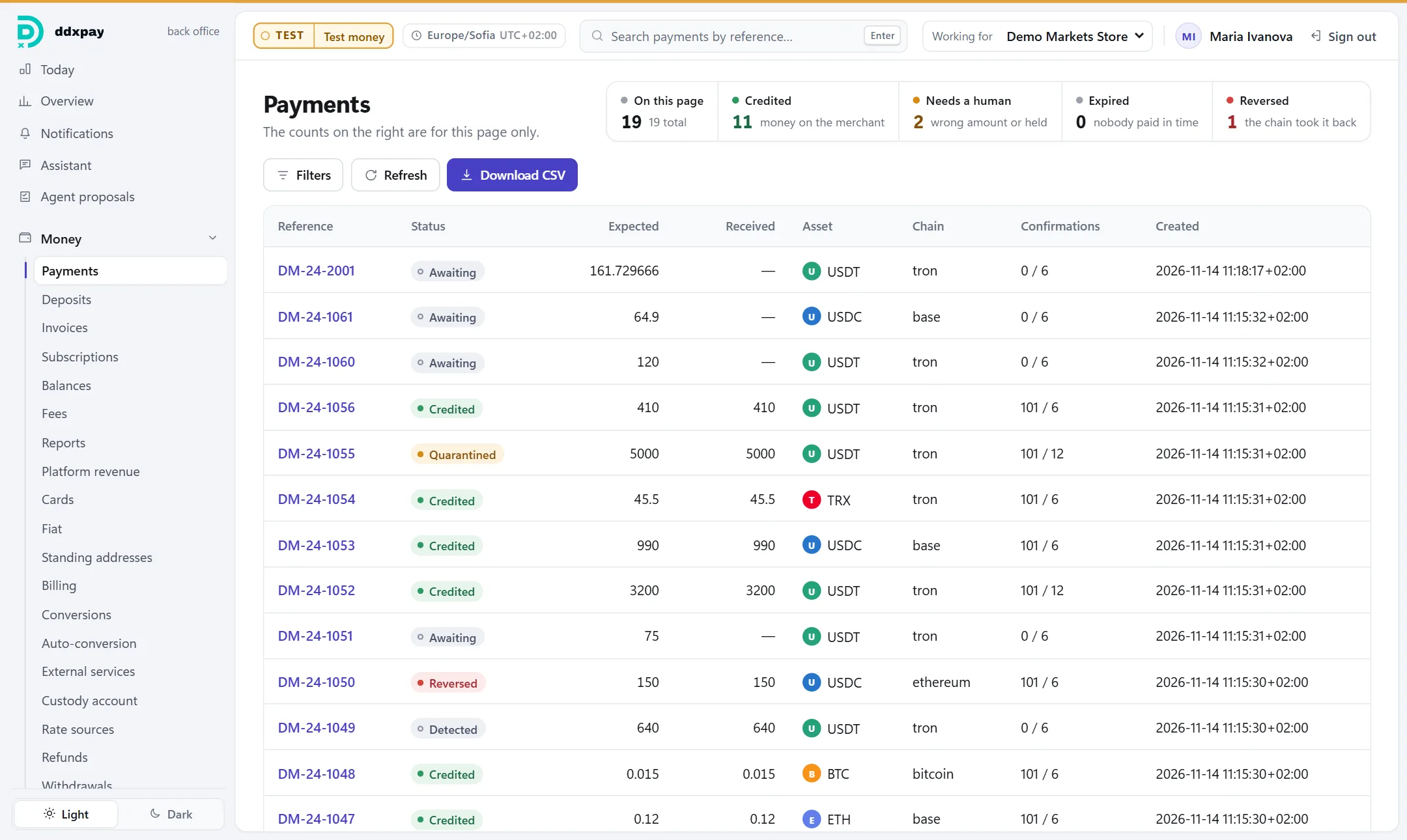
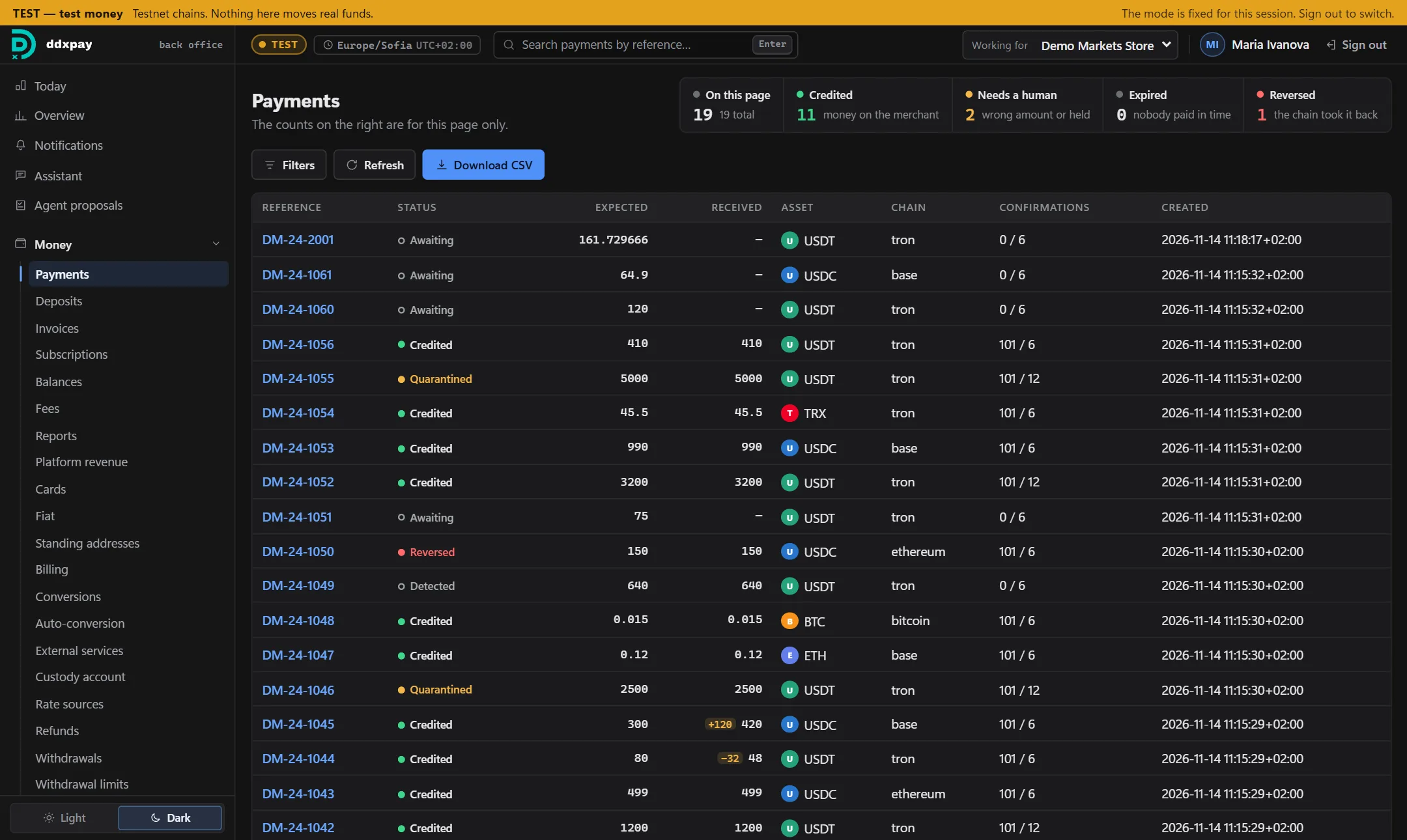
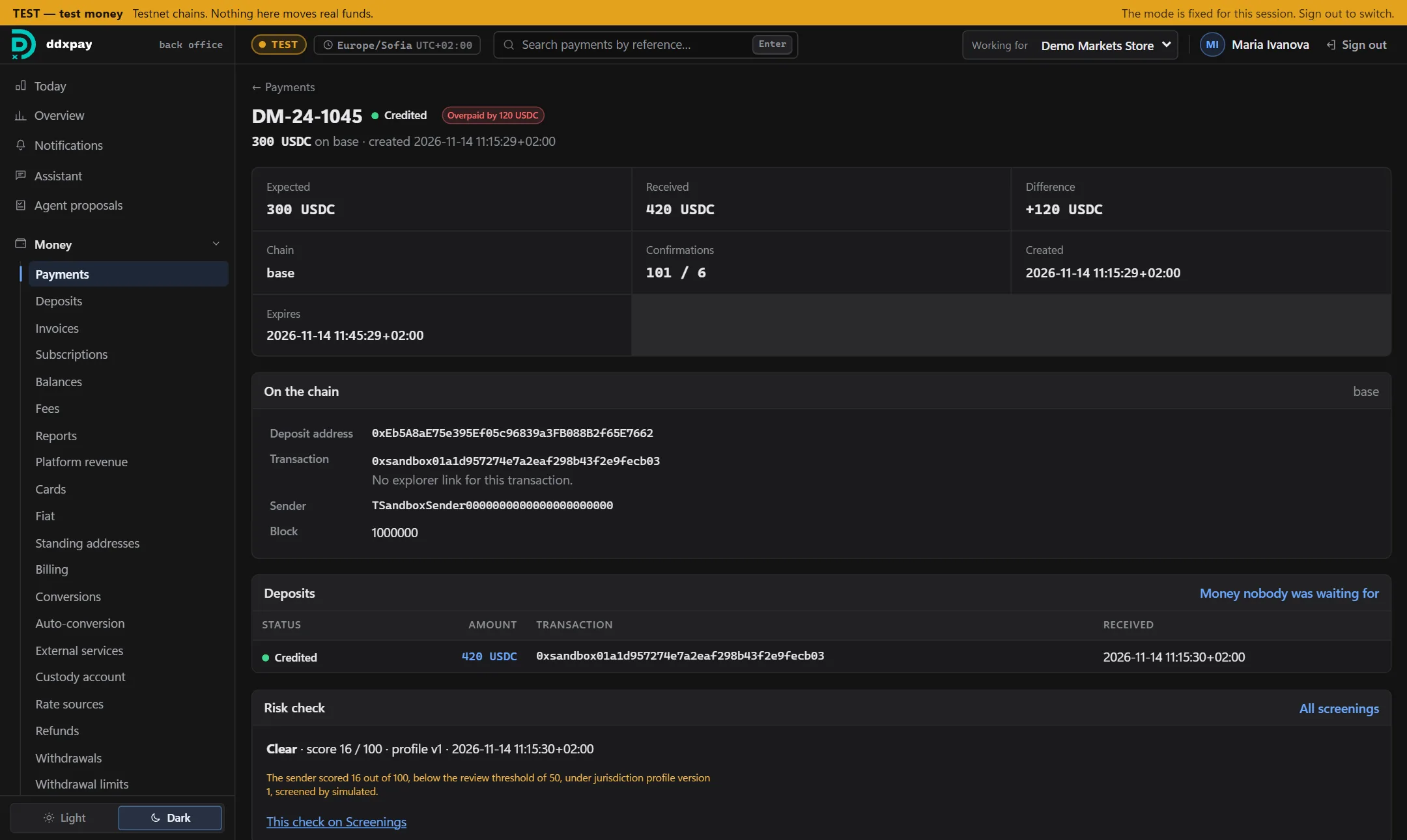
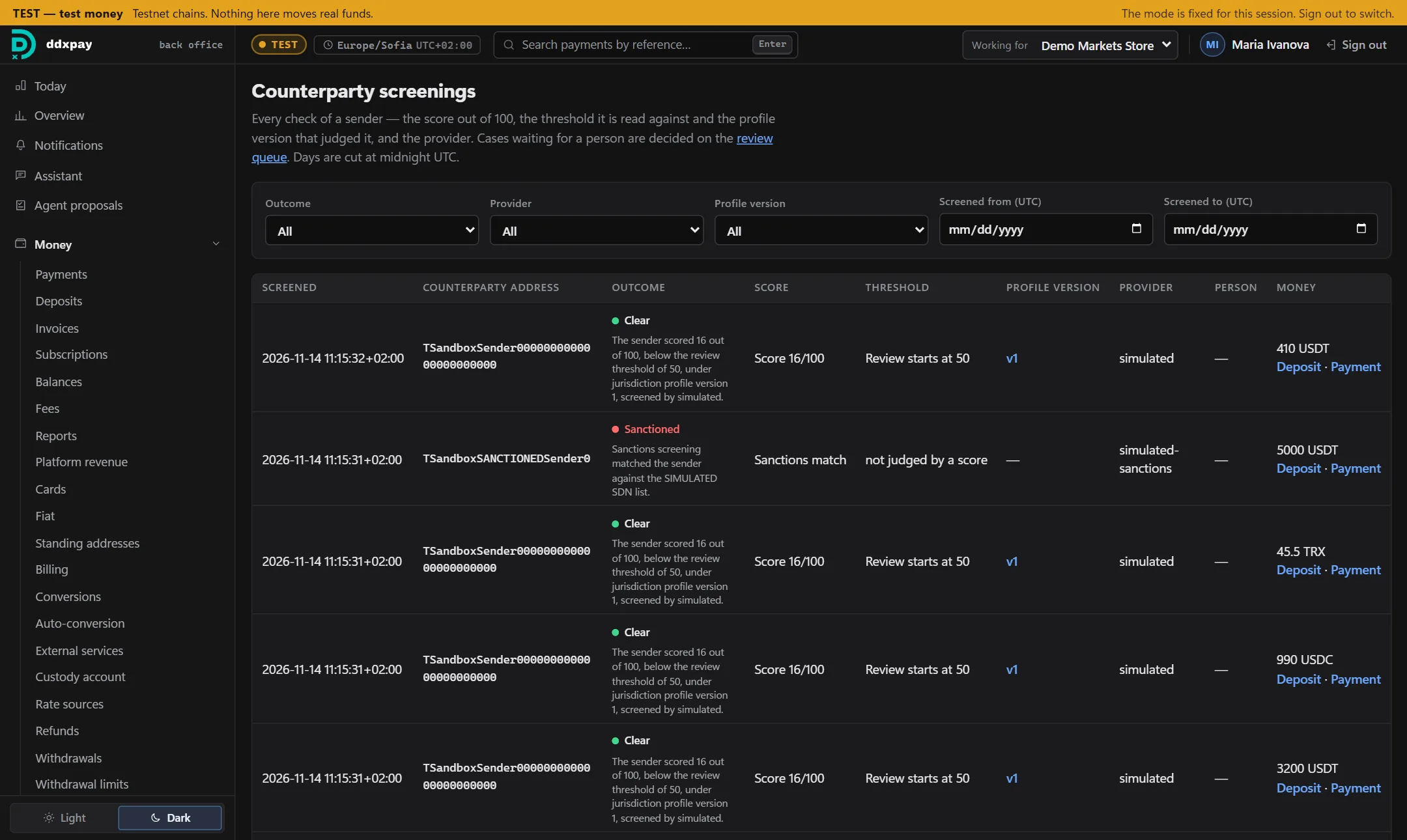
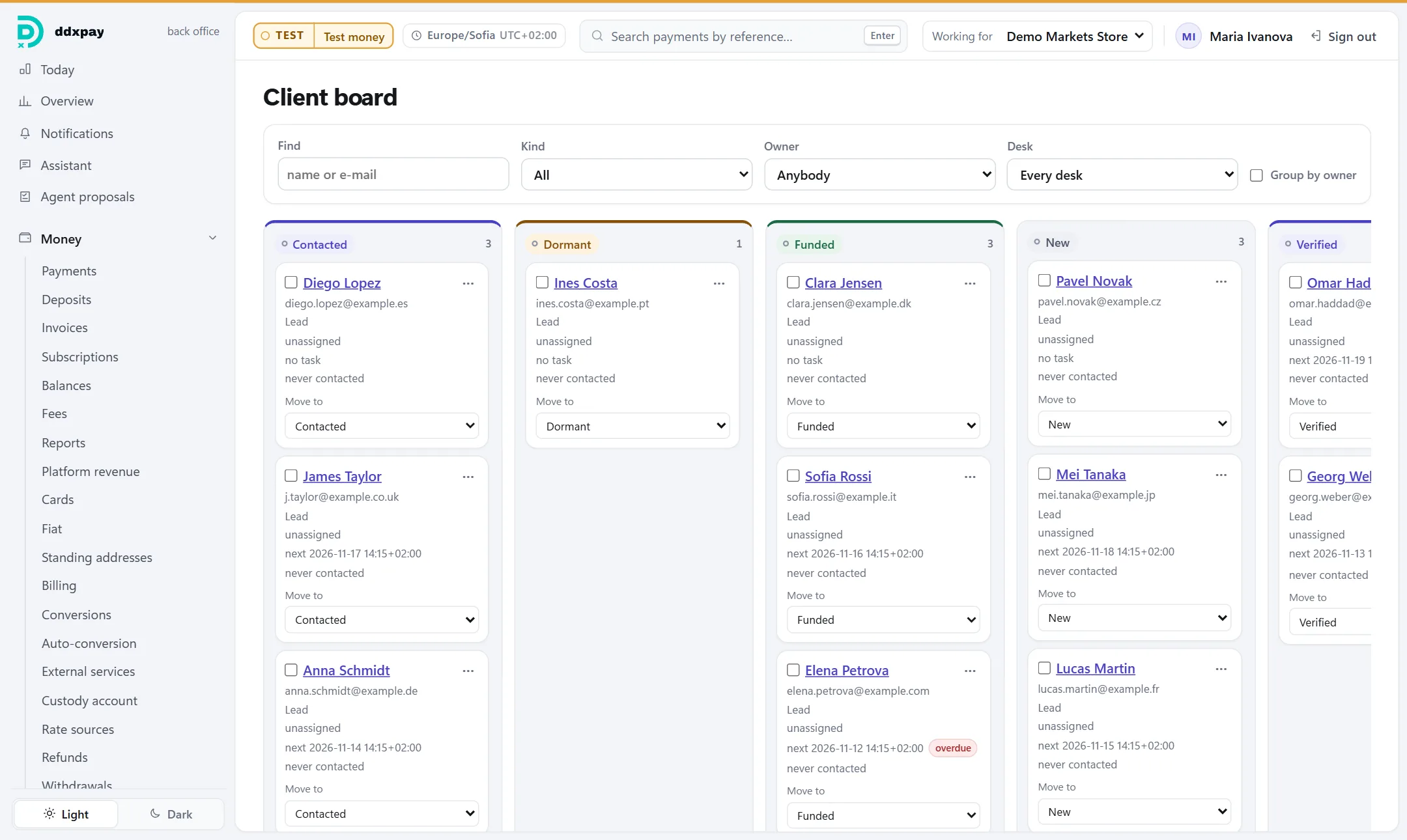
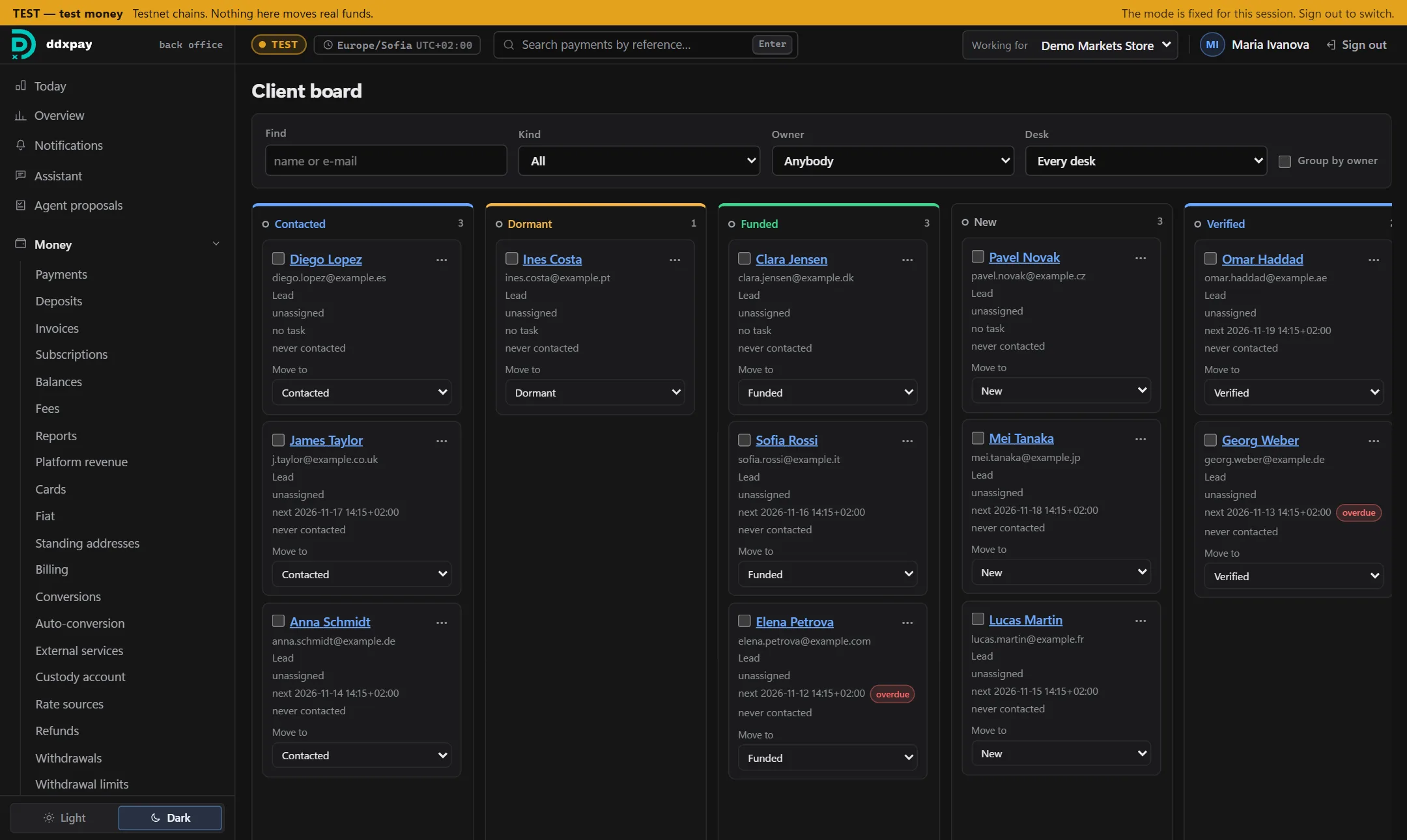
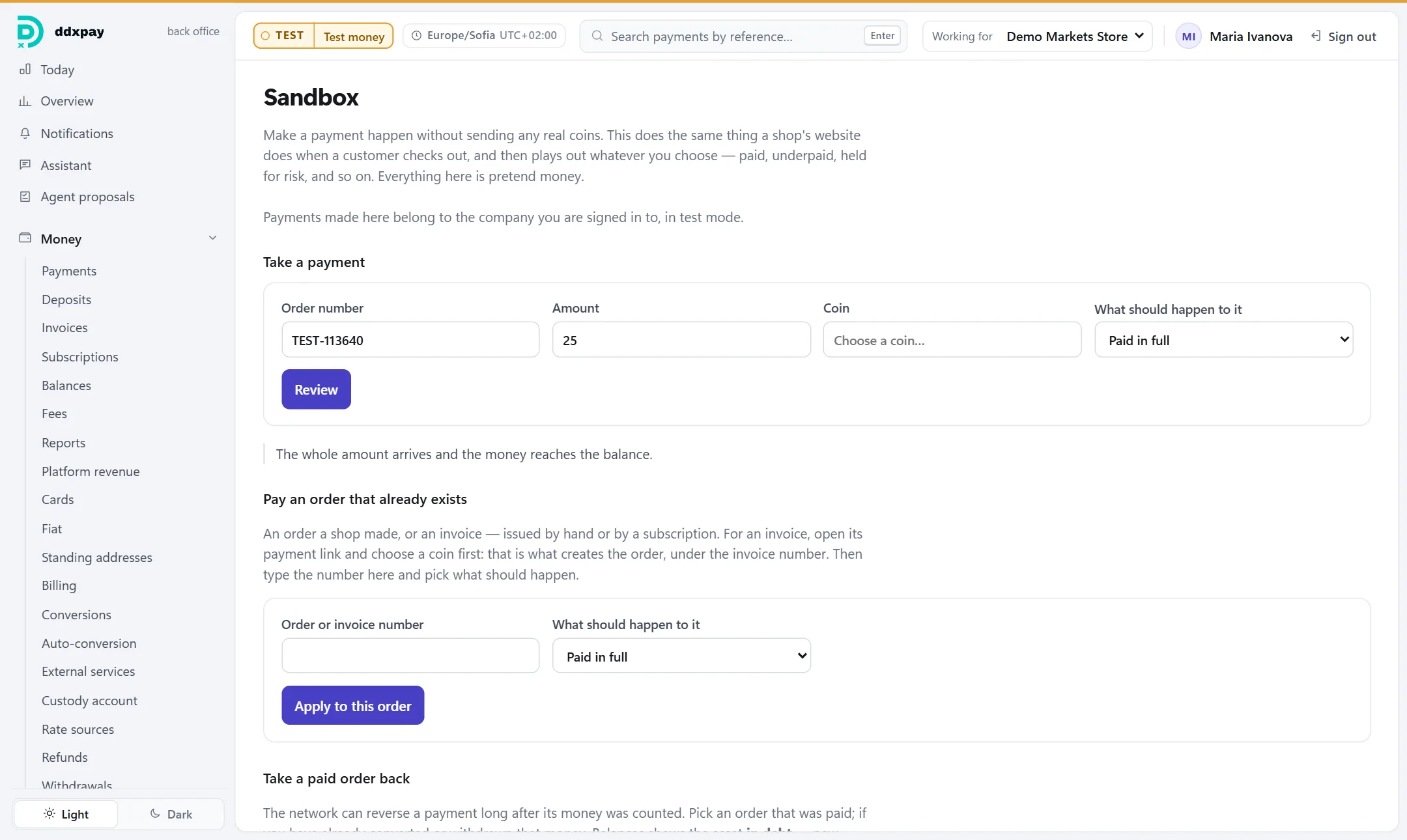
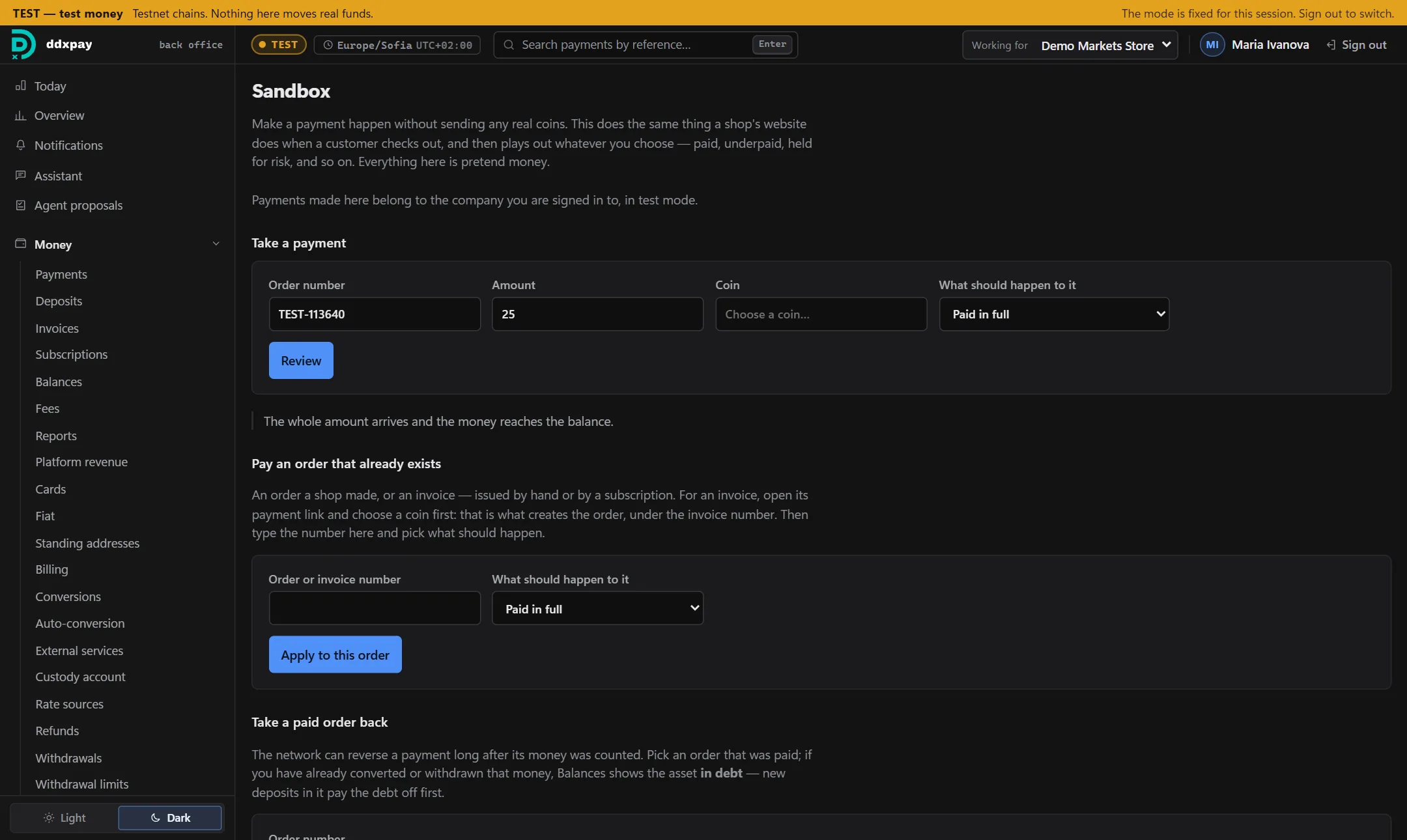
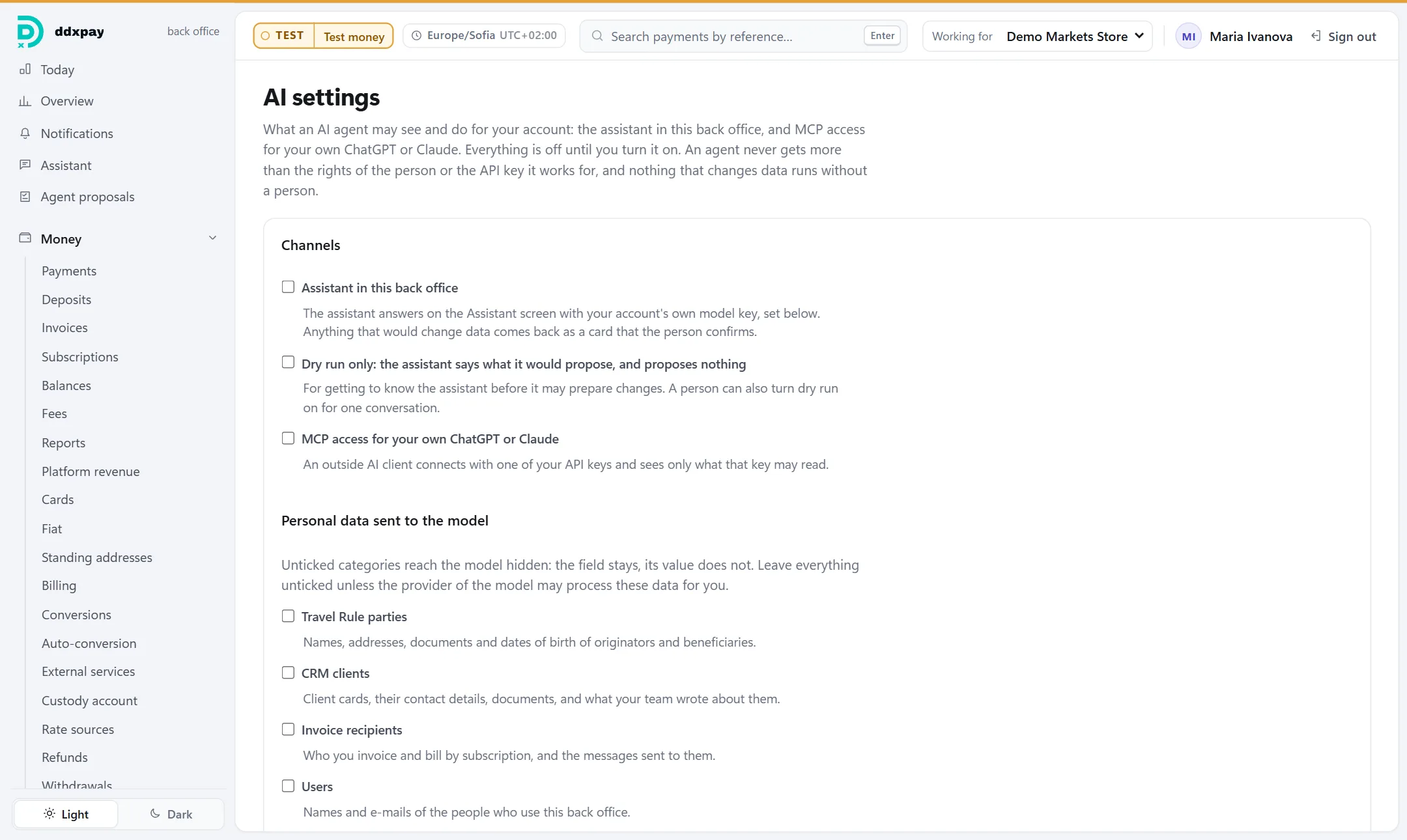
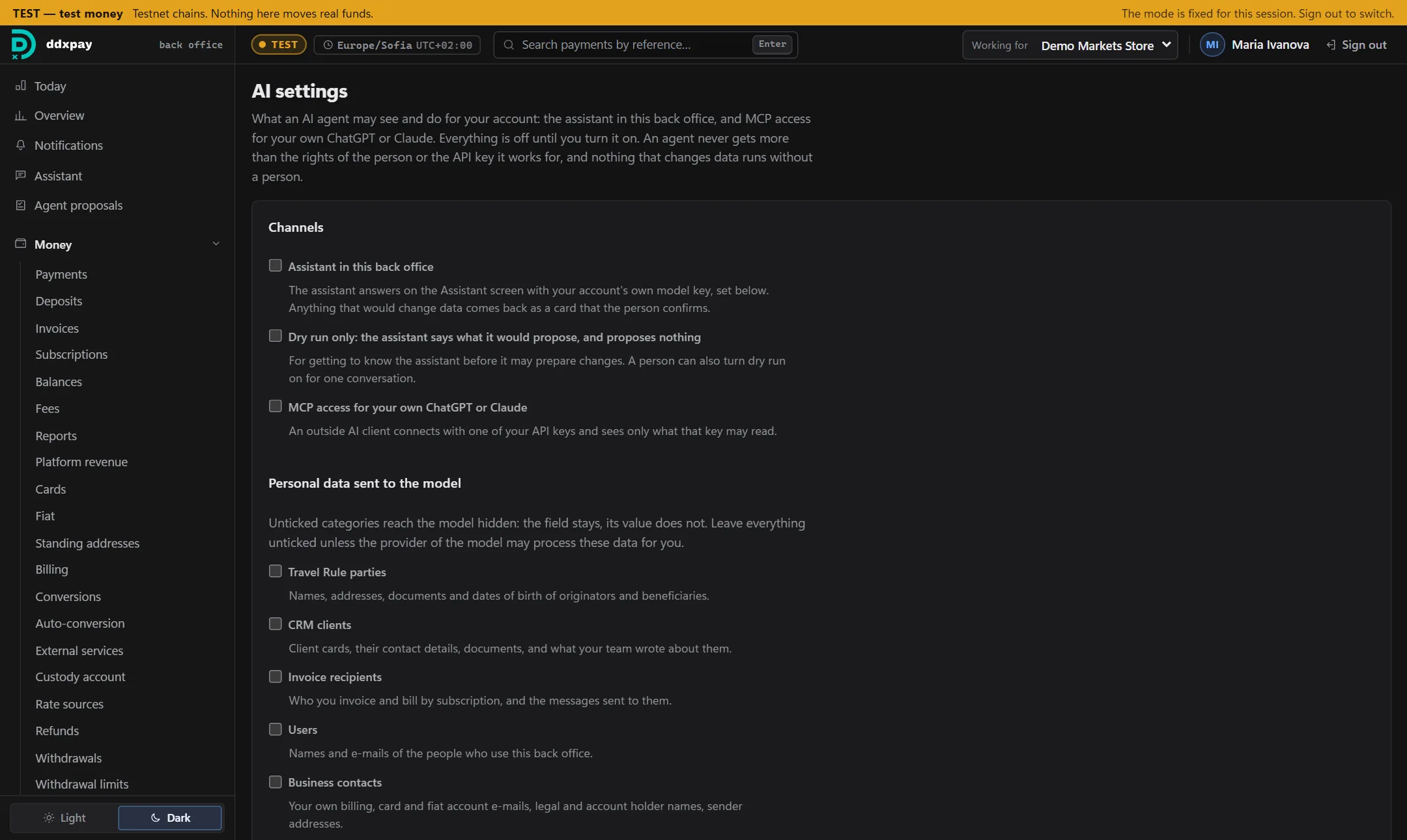
Real screens of the DDXPay back office, running in test mode with sample data. Light and dark, like the rest of this site.
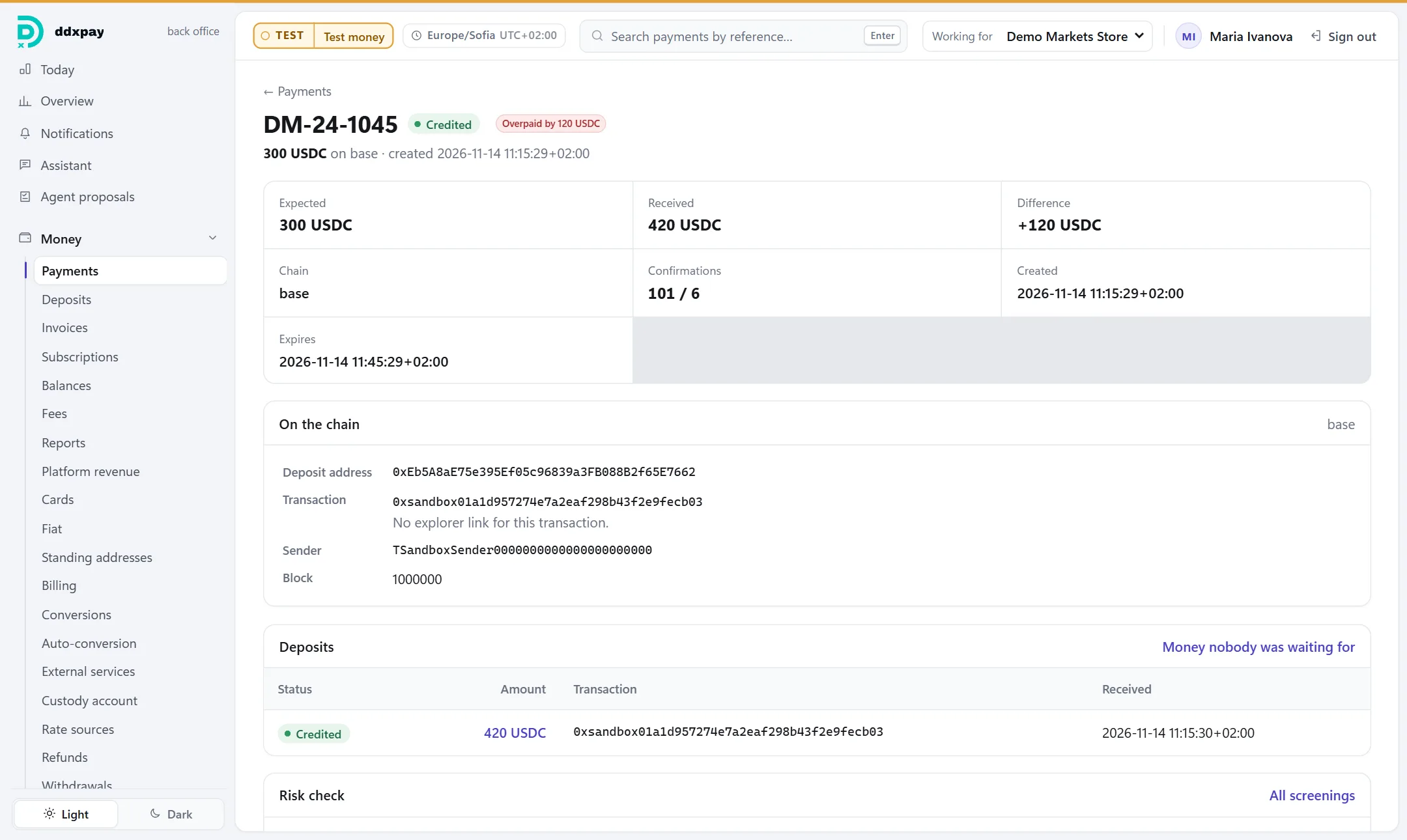
Payments
Status is a colour and a word: an operator scanning twenty rows finds the ones that need a person without reading them all.
Payment
One payment, start to finish: the transaction and its explorer link, the risk check, the deposit, the webhooks and the refunds — each with the moment it was recorded.
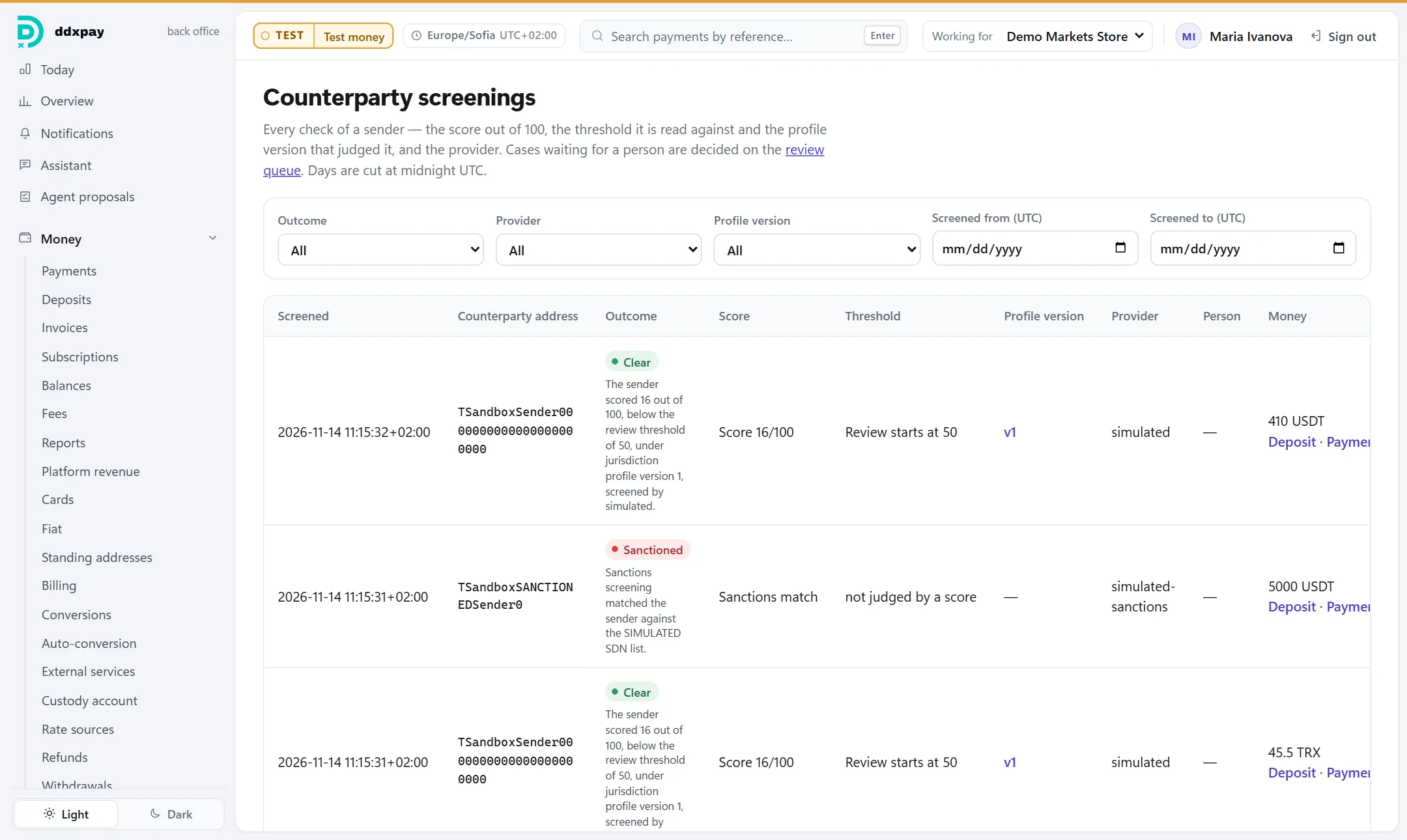
Counterparty screenings
Every screening shows its score, the threshold it was read against, the profile version that judged it and a sentence a person can repeat to a client.
Client board
A column per status, a card per client. Drag a card to change its status; the history records who moved it and from where.
Sandbox
Take a test payment and choose its fate. It runs through the same pipeline as a real one, so what you see here is what you get in live mode.
AI settings
Everything is off until you turn it on: which channels, which operations, and which categories of personal data reach the model.
Solutions
One core, shaped for how you sell.
The payment core does not know what a broker or an order is. What differs between businesses lives in configuration and in the modules on top — never in a fork of the code.
# Price in euros; the buyer pays USDT on Tron at a locked rate.
curl https://api.example.com/api/v1/checkout-sessions \
  -H "X-Api-Key: $DDXPAY_API_KEY" \
  -H "Idempotency-Key: order-10482" \
  -H "Content-Type: application/json" \
  -d '{
    "reference": "order-10482",
    "fiatAmount": 149.00,
    "fiatCurrency": "EUR",
    "assetSymbol": "USDT",
    "chainName": "tron"
  }'
import { DdxPay } from"@ddxpay/sdk";
const ddx = new DdxPay({
baseUrl: process.env.DDXPAY_BASE_URL,
apiKey: process.env.DDXPAY_API_KEY, // ddx_test_… or ddx_live_…
});
const session = await ddx.createCheckoutSession({
reference: order.number, // also the idempotency key
amount: order.total,
assetSymbol: "USDT",
chainName: "tron",
});
import { verifyWebhook } from"@ddxpay/sdk";
app.post("/hooks/ddxpay", express.raw({ type: "application/json" }), (req, res) => {
const result = verifyWebhook({
body: req.body.toString("utf8"), // the raw body
headers: req.headers,
secret: process.env.DDXPAY_WEBHOOK_SECRET,
now: Math.floor(Date.now() / 1000),
});
if (!result.ok) return res.status(400).send(result.reason);
handle(result.event); // event.id de-duplicates retries
res.sendStatus(204);
});
Security & compliance
Built to the strictest standard. Configured for yours.
The compliance features are engineered to the level of the strictest regime we know — the EU — so that whatever applies to you can be switched on and tuned, not built later.
Isolation in the database
Data is tagged with its tenant and, for money, its mode. PostgreSQL row-level security refuses everything else — and fails closed.
Test can never touch live
The mode comes from the key, never from the request. A test key cannot reach a live adapter — checked on every build.
Four eyes on money
The person who requests a withdrawal cannot approve it, and nobody can grant rights they do not hold themselves.
An audit trail that cannot be edited
The application can only add audit rows, never change them. Refused attempts are recorded too.
Secrets stay secret
Provider keys are encrypted at rest and never returned by the API — a screen shows the last four characters, nothing more.
Frozen funds are a state
Stablecoin issuers can freeze an address at any time. A freeze is a ledger state: free and total balances stay honest.
Fees are agreed per client. Tell us what you sell, which chains your customers use and roughly what volume you expect — we will show you the platform on your own scenarios.