The platform
Everything between “paid” and “paid out”.
DDXPay is one application with one database and one double-entry ledger. Each module below is a set of operations with the same permissions on the screen, in the API and for the AI assistant.
Accept
Payment gateway
A payment intent per order, a deposit address per payment, and a state machine that says exactly where the money is.
- Tron, Ethereum, Base and Bitcoin — USDT, USDC, ETH, TRX and BTC. Each asset is tied to its chain and network, so USDT on Tron can never be added to USDT on Ethereum by mistake.
- Confirmations by amount. Bigger payments wait for more blocks. A block that disappears in a reorganisation reverses the payment with a compensating entry — nothing is deleted.
- Exactly once. A transaction is recorded once per chain, hash and log index, however many times a node reports it.
- Every outcome has a state. Underpaid, overpaid, expired, reversed, quarantined — and a payment in an asset nobody expected waits for a person’s decision instead of being credited blindly.
- Money nobody was waiting for — a late payment, a second transfer to an old address — is recorded as a deposit and shown in its own list, not lost.
- Standing addresses per chain for a merchant, for top-ups that are not tied to one order.
Checkout
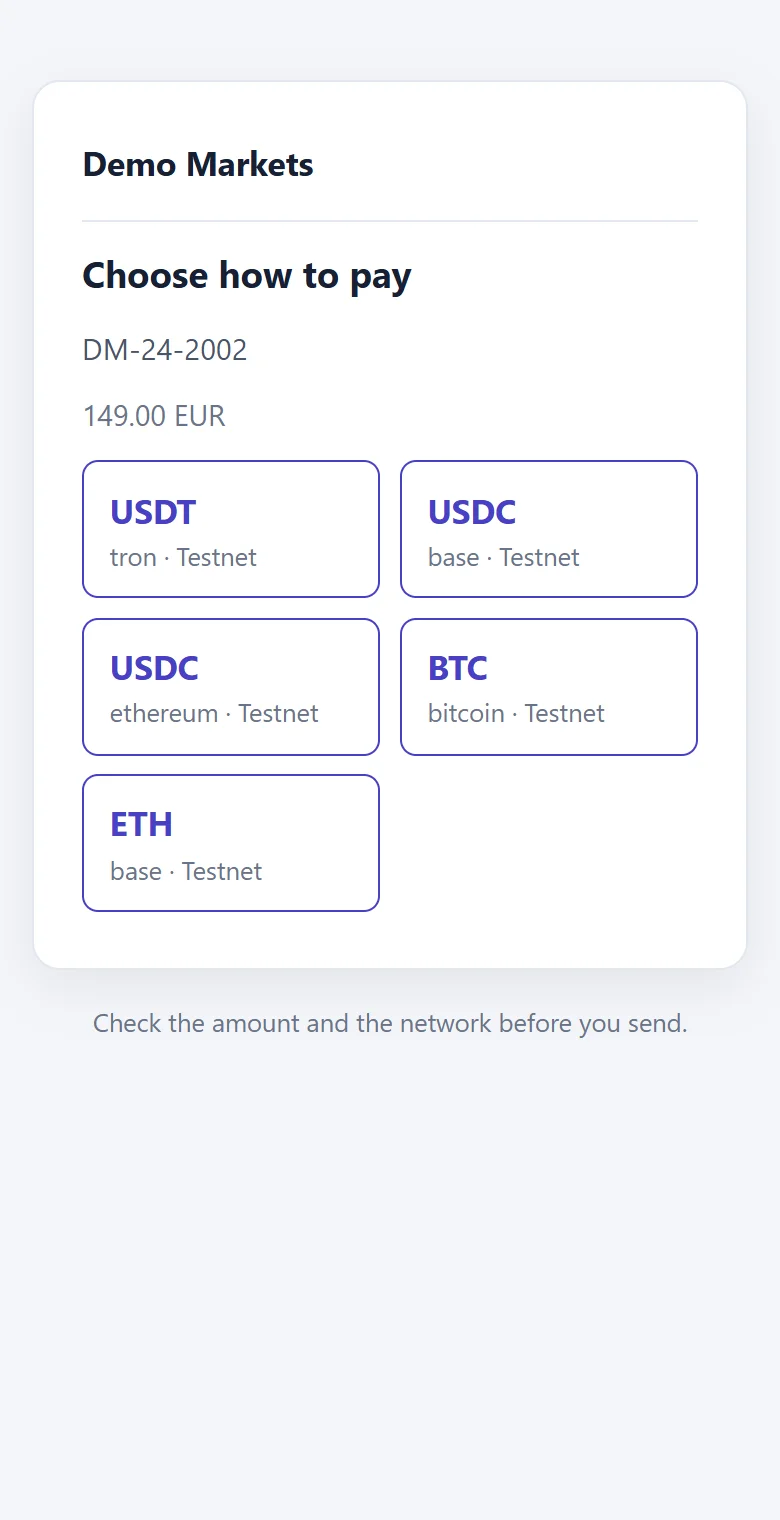
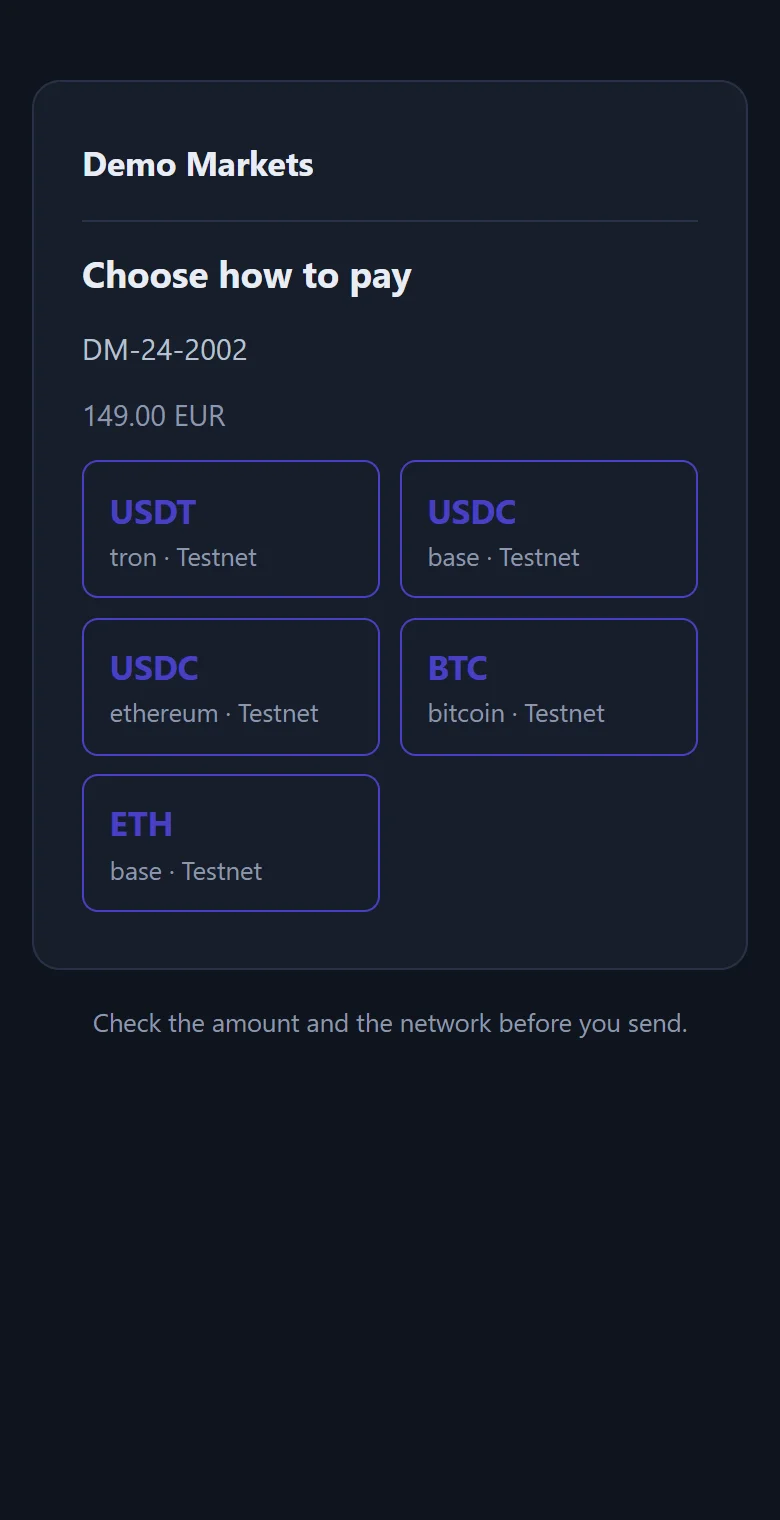
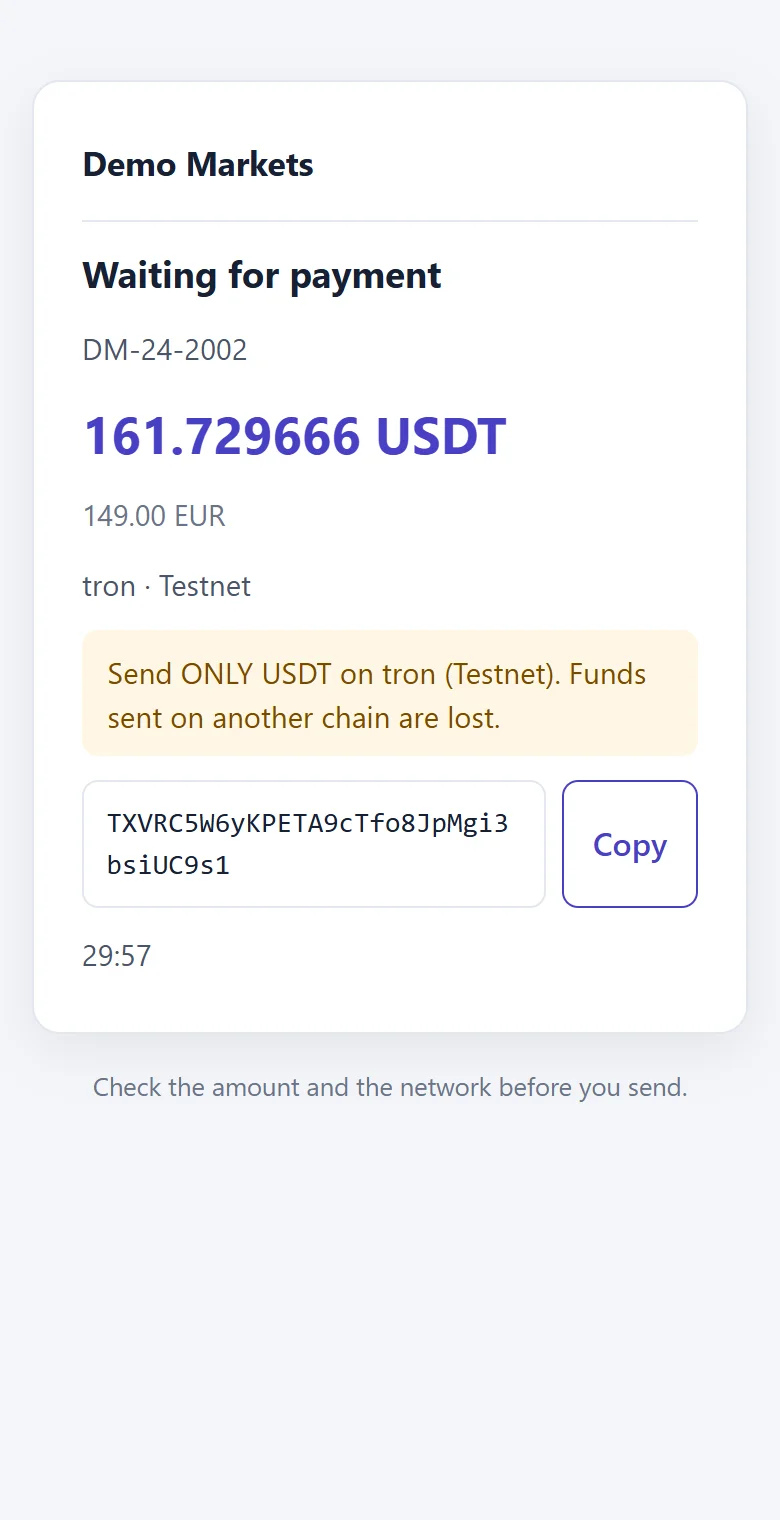
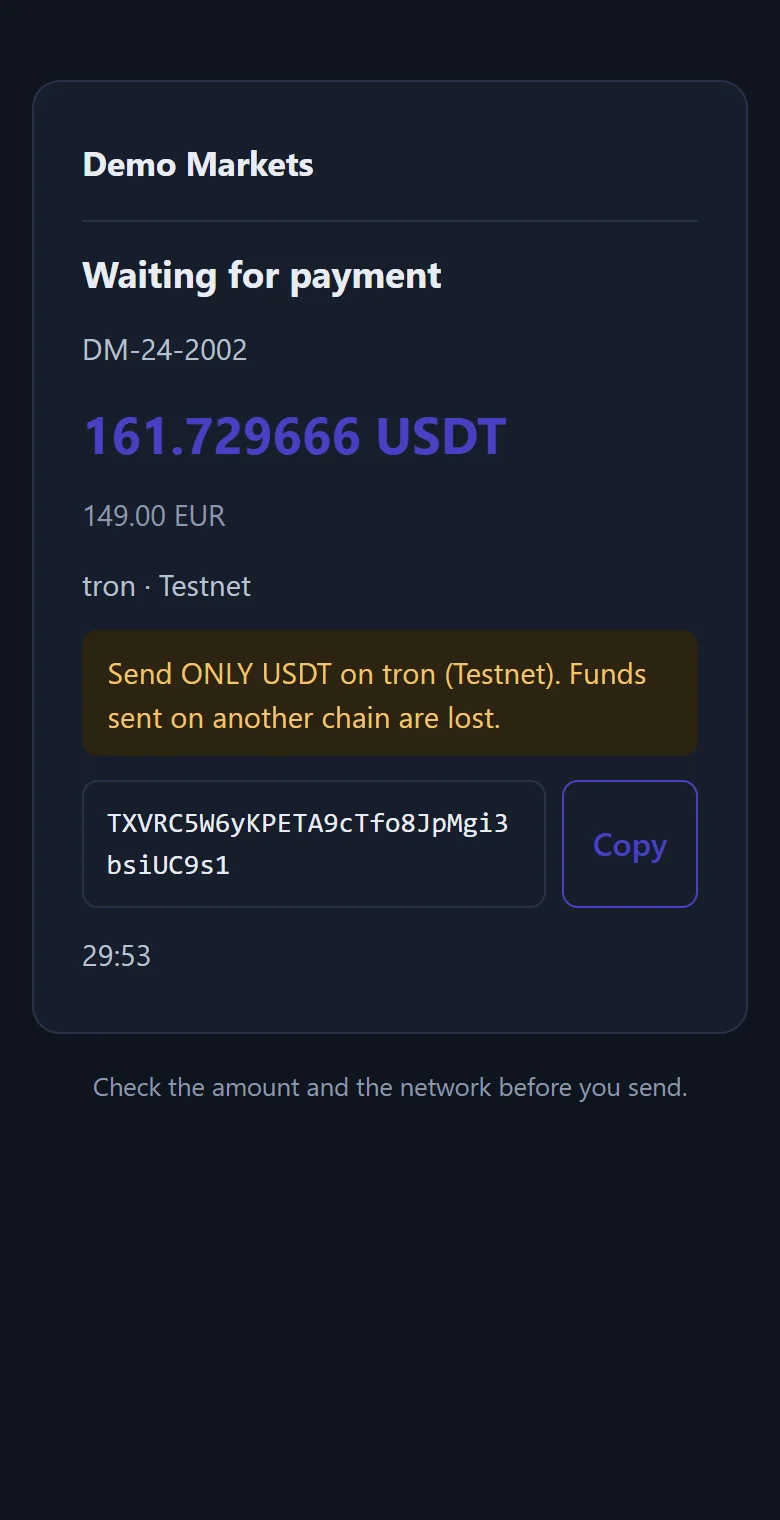
Three ways to take the payment: our hosted page, a widget inside your page, or your own UI on top of the API.
- Price in fiat, pay in crypto. The rate is locked for a short window and stored with the payment as a historical fact, not recalculated later.
- The buyer chooses the coin. Offer the assets and networks you accept; the rate is locked only when the buyer picks one.
- Hosted payment page for links in e-mails and invoices, and an embeddable widget of about 3 KB with no dependencies.
- Your brand — name, logo and accent colour — on the page your customer sees.
Invoices & subscriptions
A document layer on top of payments, for B2B sales and anything billed by period.
- Numbered invoices with recipient, lines, your issuer details and the buyer’s PO number. VAT is calculated per rate, as tax authorities expect, not per line.
- A payment link that survives an e-mail. The page stays valid until the due date; the buyer picks the coin when ready to pay.
- Paid, unpaid, overdue — read from the payment itself, so the invoice and the money never disagree.
- Subscriptions issue each period’s invoice automatically, with numbers derived from the period, so a repeated run never issues the same invoice twice.
- Print or save as PDF from a print-ready page.
Card payments
Cards next to crypto, through the merchant’s own Stripe account.
- Onboarding from the back office to a connected Stripe account; card money and disputes stay with the merchant’s account.
- One checkout per order on Stripe’s hosted page, with the platform fee taken as an application fee.
- Webhooks for your shop when a card payment is paid, fails, expires, is refunded or disputed.
Protect
Custody your way
Non-custodial by default: DDXPay is the software that orchestrates the money, not the place where it is kept.
- Your own custodian account. Connect Coinbase Prime: deposit addresses come from your portfolio, withdrawals and refunds leave from it, and its balances are reconciled against your ledger.
- Your own addresses. Attach a deposit address from your own wallet infrastructure to each payment; DDXPay watches it and books what arrives.
- Keys are never ours to hold. Your custodian key is encrypted at rest, never shown again, and checked with a read-only call before you rely on it.
- Custodians sit behind a port, so adding another is an adapter, not a rewrite of the payment core.
KYT, sanctions & Travel Rule
Every deposit is screened before it is credited. The rules are configuration; every decision remembers which rules judged it.
- Sanctions first, always. Sanctions screening runs before anything else and cannot be switched off or released by a person.
- Risk score against your thresholds. Below the review threshold the money is credited; above it a person decides; above the quarantine threshold it is held.
- Versioned jurisdiction profiles per merchant: thresholds and the Travel Rule limit change by issuing a new version, and the old decisions keep theirs.
- A review queue with reasons. The person who decides writes why, and the decision goes through the same path as the automatic one.
- Travel Rule on outgoing transfers. Above your threshold, a withdrawal or refund without originator and beneficiary data is refused at approval and again at sending. A zero threshold means every transfer.
- Provider choice. Risk scoring through Chainalysis or Global Ledger; sanctions through Chainalysis. Test mode uses a deterministic simulator.
Received Travel Rule messages can be recorded by hand today. Automatic exchange with other providers over a Travel Rule protocol is on the roadmap.
Frozen and held funds
Stablecoin issuers can freeze an address without warning. That is a state of the ledger, not a surprise in it.
- Every balance is two numbers — free and total. Everything that spends reads the free one.
- A freeze is a transfer into a holding account, per request, with partial release and a history.
- Sanctions and issuer freezes are separate, because different people lift them.
Book & move
Double-entry ledger
Every movement of money passes through one append-only ledger. No balance is ever computed by hand.
- Balanced by construction. A transaction that does not sum to zero cannot be written. Corrections are mirror entries; nothing is deleted.
- Fees are booked where they happen — on deposits, conversions and withdrawals — as their own transactions, so reports can tell them apart.
- Reconciliation with the custodian. Book balances are compared with what the custodian holds, with no tolerance and no automatic “fix”. A silent custodian is a failure, not a match.
- Reports for any period, by movement type and asset, day by day, with a dollar value recorded at the moment of booking and CSV export.
Payouts & refunds
Outgoing money is where internal fraud happens. The controls carry the weight.
- Four eyes. The person who requests a withdrawal or refund cannot approve it. Approval reserves the money; only the confirmed transfer settles it.
- Address allowlist with cooling-off. A newly approved address becomes usable only after a waiting period, and a revoked address stops even an approved payout.
- Limits per asset — per withdrawal and per calendar day.
- Payout runs. Import many lines from CSV and decide once; every line still passes the same allowlist, limits and free-balance checks.
- Refunds tied to the payment, capped at what was received, sent to the sender’s address by default.
- Request → decision → sending → confirmation, each with who did it and when.
Withdrawals and refunds leave from a connected custodian account that can send — in the non-custodial model, the client’s own.
Conversions
Swap one balance for another by hand, or let a rule remove the price risk the moment money arrives.
- Auto-conversion rules per incoming asset, with a minimum amount and a maximum slippage.
- Rates from several sources in order — Binance, Kraken, Coinbase — and a quote that fails loudly rather than guessing.
- Execution as a limit order on a connected exchange account (Coinbase today), filled completely or not at all.
- Every conversion remembers why it happened — by hand or by rule.
Fiat ↔ crypto
Off-ramp to a bank account and on-ramp from one, through a fiat-rail provider that keeps the fiat side.
- A merchant account at the provider (Bridge), opened from the back office, with the provider’s own verification and terms.
- Bank payout routes — an IBAN for EUR or a US account for USD. A withdrawal to the route’s address arrives as fiat in the bank.
- Virtual accounts in USD and EUR that pay into the merchant’s standing crypto address.
- Each exchange is recorded as a fact with both sides, the fee and the status, and reaches your shop as a webhook.
Available in test mode today. Live use follows the provider’s onboarding and terms.
Operate
Back office
Every operation, setting and check is on a screen — nobody needs a terminal to run the business.
- “Today” answers one question: what is waiting for a person right now — approvals, held deposits, alarms — and every card opens the list behind it.
- Ready-made roles — Operator, Approver, Compliance officer, Manager, Observer, Administrator — or exact permissions per person. The menu shows only what a session can reach.
- Test and live mode always visible, two-factor sign-in with recovery codes, and sessions per device that can be ended one by one.
- Diagnostics on screen: background processes, queues, chain watchers, reconciliation and the audit log, with links to where each problem is fixed.
- Light and dark themes, and times shown in each person’s own time zone.
CRM
A sales and retention CRM on the same data as the payments — no integration in between.
- Client cards with status, owner, desk, conversion, retention and compliance roles, custom fields and a full change history.
- Boards you drag: clients by status, tasks by due window, with keyboard support and group actions.
- A desk tree for the sales organisation, with visibility that follows it.
- A funnel built from real money: first deposit, qualified first deposit, deposits and net deposit per currency, from payments linked to the card.
- Lead import from CSV, duplicate warnings, saved views and excluding a card instead of deleting it.
Notifications
Tell your people and your customers what happened — with your own templates and your own sender.
- In-app feed where each event reaches the people whose permissions cover it.
- Rules: on this event, send this template to this address — by e-mail (Amazon SES) or SMS (Amazon SNS).
- Templates per language with a preview, and a rendering that refuses to send a message with a missing value.
- Every rule says when it last worked and, if it failed, where to fix it.
AI assistant & MCP
Not a chatbot on top: every operation is a tool the moment it is written, with the same permissions as the person.
- Assistant in the back office with your own model key — Anthropic, OpenAI or an OpenAI-compatible server.
- Reads on its own, proposes the rest. Anything that changes data arrives as a card with the exact operation and arguments; a person confirms or dismisses it.
- MCP for your own AI client. Connect Claude Code or another MCP client with an API key: it reads what the key may read and proposes changes for a person to confirm.
- Personal data stays hidden unless you allow a category — Travel Rule parties, CRM clients, invoice recipients, users, business contacts.
- Off until you turn it on. Every turn of the model is logged with its tokens and cost.
Operations that carry secrets are never available to an agent. Sign-in for hosted assistants over OAuth is on the roadmap.
Coming next
On the roadmap — not available yet.
We list what we are building so you can plan with us. None of this is part of the platform today.
- Coming soonOwn trading platformInstruments, trading groups and a web terminal for a broker’s clients, with profit and loss in the same ledger.
- Coming soonPartners and IB portalIntroducing brokers as a tree inside the tenant, with commission rules and their own area.
- Coming soonConfidential transfersPrivate transfers with viewing keys for selective disclosure to compliance.
- Coming soonRecurring mandatesPayments the customer authorises once and that run on a schedule.
See it on your own scenarios.
We will walk you through the platform in test mode with the chains, assets and flows you actually use.